
Rick Antonson -Travel Writer
A Career After 70!

Susan Gerle, author of “Aging with Style,” writes articles of interest for people who are actively aging, especially after retirement. She recently had the opportunity to interview a former CEO, Rick Antonson, who changed his career path in retirement to become a full-time writer.
Susan - Rick, your newest book, ‘Train Beyond the Mountains,’ is your fifth travel narrative. You wrote your first one, ‘To Timbuktu for a Haircut,’ in 2008 when you were still working in the corporate world. How long ago did you leave your corporate position and become a full-time writer?
Rick - First off, let me say that “Aging with Style” is an inspired tag for your work Susan as it captures everything from "life-long learning" to “don’t let the old man in” (as Clint Eastwood famously says…). I commend your succinct designation of what a world of folks our ages aspire to achieve.
Susan - Thank-you.
Rick - More directly to answer your question, it’s been a rather swift-feeling ten years since I stepped away from CEO/president responsibilities to focus as a full-time book author. At the time, my wife Janice (who continued working as an aviation executive around the world) and I concocted a plan (thinking of money and where we’d be living) for me to “have a go” at my new career for five years — and it has worked really well (though not with as significant of a financial contribution on the home front from royalties, as most any author will admit...). I settled into the writerly life quickly given I could do that from our home in Vancouver or wherever Janice was posted (Bahamas and elsewhere initially and then Australia as a start of being with her for extended periods, then Germany).
Susan - What is ‘Train Beyond the Mountains’ about and why did you decide to write this current book?
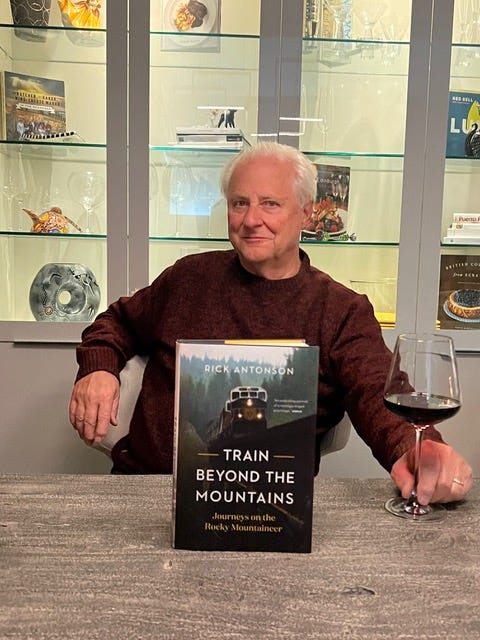
Travel Writer/ Author, Rick Antonson, relaxing at home after a full day of writing and researching.
Rick - Curiously, most of the places I’ve written about are difficult for travellers to follow up with a journey and enjoy in person — if you and I went to Timbuktu today, we’d be at risk of kidnapping (and my Kidnap & Ransom Insurance expired when I left the corporate world…just sayin’). Summiting Mount Ararat is today frequently frowned upon by the Turkish government. Trekking in Papua New Guinea has been in the news because of dangers rather than because of enjoyable experiences. Yet, somewhat as a balance to those traveller quandaries, it is safe, fascinating, and invigorating for readers of “Aging with Style” to journey on the Rocky Mountaineer. That’s part of the context for writing this book. Another is that my travel companion “Peter” whom readers met in my book Route 66 Still Kicks, Driving America’s Main Street, is founder of Rocky Mountaineer and once said, “Why don’t your write a story like your other travel adventures, full of history and geography, one about trains and journeys, since you’ve ridden trains in dozens of countries and have an unusual perspective…and contribute to the conversation about the Rocky Mountaineer...” (I paraphrase, but there you have it. That was the start, but I was unsure if there was a book in the suggestion. Well intentioned individuals/readers are always suggesting “Here’s a great idea for your next book” to authors and seldom are they helpful. This one was.)
All that and then I decided being on one of the most famous trains in the world needed an accomplice, and invited my 10 year old grandson Riley — and that changed the dynamic of my travels, shifted not just my writerly encounters with explorers or historic personages but my interactions with fellow travellers, all the while revealing a set of experiences gained through eyes that were 1/7th the age of mine. It made for an incredible, unpredictable, invigorating narrative thread throughout the book.
Susan - Substack is a writers' platform. Can you share one thing that you love about writing that may only resonate with other writers?
Rick - It is that I love constantly learning how to improve one's craft. This has often come through my making mistakes. For example: I fell in love with Dorothea Lange, the amazing photographer from America in the 1920s who photographed Route 66. The editor read my 3,500-word paean and said, “Nice piece but it’s so long I forgot I was on a road trip. Make the piece 800 words…” Or I always write long (my Timbuktu book first draft was 120,000 words; the final is 88,000 and editor John Eerkes-Medrano said to me as he carved away at it, “Rick, we still have room for fewer words…”.
Susan - So many people retire not only from their job, but from life in many ways, replacing a career with a big screen TV, being entertained by other people’s stories. You have chosen yet another career, which includes telling your own stories. What would you share with others approaching retirement or already retired what you hope they will do with the rest of their lives?
Rick - Everyone has stories. For those who find they have time on their hands, my encouragement is to tell your stories. How one shares them is quite personal and may be through music (I cannot sing except maybe the low voice of Lee Marvin’s “I was born under a wandering star” which I love for its message) and am not a visual artist (I can’t connect two dots), so have huge respect for those who chose to share stories through one of those mediums. I’m quite taken with the notion of “legacy" and the concern that most people intend on leaving what could be called “chequebook legacy” (left over funds, left behind money) which is nice, but what about leaving other generations your stories? — find a way to dictate them in an interview with a grandchild and record them on your phone, then get them transcribed, for example. What about portraying one’s life in paintings, if that’s your talent — sharing what they mean and why you hope future generations care about them, and therefore make such art a legacy of your life.
Susan - Is there anything besides writing that you enjoy doing now that you didn’t have time to do before you retired from your corporate career?
Rick – I work at my writing 35 to 45 hours most weeks now. In summer, I play baseball twice a week — a great group of over-the-mound fast pitch folks who have grown fond of slow pitch, slow running, and slow moves. And who no longer feel that victory needs a loser, rather that winning this week means you’ll just as likely lose the next game and have as much fun doing so as with winning.
Susan -You are not just an author but script writer as well. Will you speak about the musical you and others are currently working on, which is based on the book you published in 2012, ‘Route 66 Still Kicks.’
Rick - I’m co-scriptwriter of the (yet to be performed) “Route 66 Musical.” I should stress, I am the “co”- in the term, as Shawn Macdonald is my partner and is an award-winning scriptwriter, director, actor, teacher, and all-round motivating force. We’ve been blessed with talent that he’s attracted to help us (Robert MacQueen has directed our seven workshops with professional actors; Bob Foster has been music director; the Vancouver Arts Club has hosted our workshops, and so forth) — Shawn has taken this escapade well beyond my personal knowledge or contacts in ways I could not have imagined, and which I admire. And today we sit with an exceptionally good Script, a full Score, and Song rights (this is a juke box musical, and we’ve canvassed hundreds of song considerations and workshopped countless ones — realizing each song needs to serve the script, evolve the story, and develop the characters). This is NOT a musical tribute — it’s a very serious storyline, and now we are looking for a producer. 2026 is the 100th Anniversary of the founding of Route 66 and we hope to see the play “on its legs,” as they say, by then...
Susan - You also co-authored a book many years ago, one of your first publishing projects, ‘In Search of a Legend-Slumach’s Gold.’ I understand you are currently working on an update. How is that coming along?
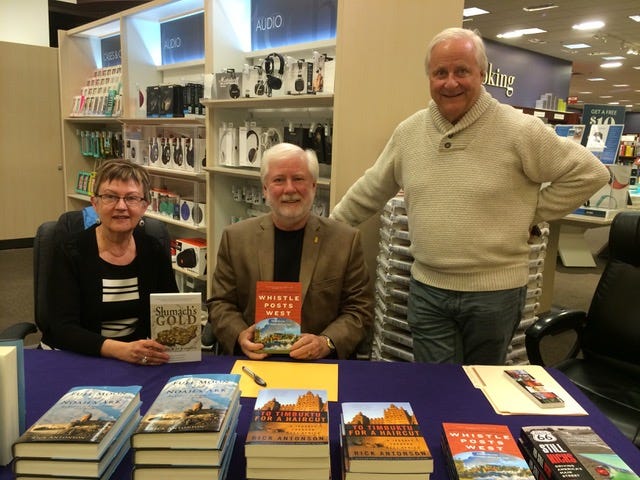
Co-authors Mary Trainer (L), Brian Antonson (C), and Rick Antonson (R) at Chapters Book Store in Vancouver.
Rick - In 1972 my older brother Brian, our friend Mary Trainer, and I collaborated on ‘In Search of a Legend-Slumach’s Gold’ which we self published in a 56-page, saddle stitch edition. It went on, in various formats, to sell 10,000 copies (this in a country, Canada, where a bestseller hit is 5,000 copies). We expanded our book by a hundred pages of new photos and research and in 2007 it was published by Heritage House — It has sold over 14,000 copies. It’s a fascinating story of a lost gold mine with a purported curse protecting it, situated in the vicinity of Pitt Lake, not far from Vancouver but which is surrounded by formidable terrain. In 1890 an Indigenous man named Slumach shot and killed another man, was arrested, tried, convicted, and hung in 1891, January. That is fact. Legend grew up around this. We signed with Heritage House to update our story with the heap of fresh tales, more detailed research, many new maps, tantalizing gossip and more lost-mine-sites— and they more recently told us they will publish it in October 2024 in a new format of 8 x 10 and with colour photographs and maps throughout, which is rather exciting. The publisher at Heritage House has changed the title to ‘Slumach’s Gold: In Search of a Legend.’ It will be a 220-page definitive work on one of North America’s most famous lost treasures.
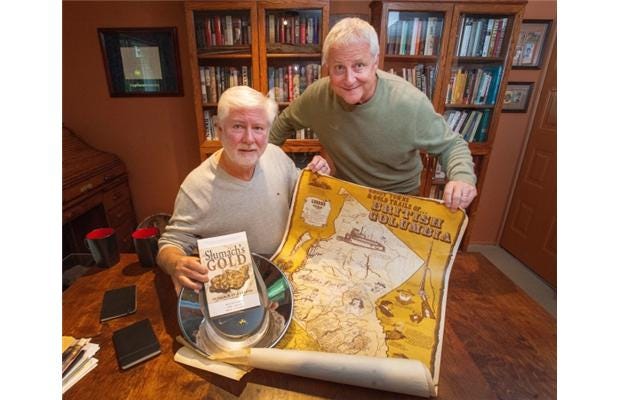
Brian Antonson (L) with Rick Antonson (R)
I might add our 1972 publication birthed a fine Canadian publishing company founded by the three of us. Nunaga Publishing released some 25 titles between 1972 and 1979 when it was sold to Douglas & McIntyre, and I joined D & M as vice president and general manager in 1982 through 1987.
Heritage House is also publisher of our other co-authored title, Whistle Post West: Railway Tales of British Columbia, Alberta, and Yukon.
Susan - To finish, please explain ‘Cathedral Thinking’ and how it is part of your belief system.
Rick - I had nothing to do with creating the philosophy of Cathedral Thinking as it’s been around for hundreds of years, at least in spirit if not by that name. However, I’ve become somewhat of an apostle for the concept. In a quick explanation it is this: if you were asked as an architect in a European city of the 1500s to design the town’s new cathedral, you’d begin your job knowing that you would not live to see it completed. Perhaps your grandson or great granddaughter would work on the final renderings. You would undertake your task with the commitment to ensure your work provided a solid foundation upon which others could build. It’s a way to keep the living generation tethered to the future. I’ve come across Cathedral Thinking used to describe everything from Australia’s approach to water conservation to Scotland’s approach to land conservancy to Dublin’s system for maintaining its sewers. Activist Greta Thumburg used it to challenge European parliamentarians to accept the ramifications of what they do today to save the planet for tomorrow’s generations, saying they needed to adopt “Cathedral Thinking” to envision long term solutions and make plans beginning today to address the situation.
Susan - Thanks Rick! Watch for the next interview, ‘Marlene Wilson - Full-Time Cowboy!’ If you are or know someone over 70 who has an interesting career later in life, please have them contact me. I may consider doing an interview with them.
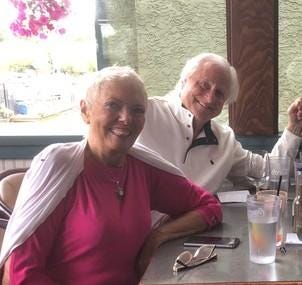
Susan Gerle and Rick Antonson enjoy a moment of reflection about aging with style!
To contact Rick, or for more information about his retirement career:
www.rickantonson.com
https://www.ricksteves.com/watch-read-listen/audio/radio/programs/program-719
Ted Talks - Cathedral Thinking - Rick Antonson on YouTube